
Lifecycle
Welcome Series Benchmark: What Top DTC Programs Send in the First 14 Days
An analysis of 312 DTC welcome programs covering the first two weeks after subscribe — cadence, structure, and the moves that distinguish the top quartile.

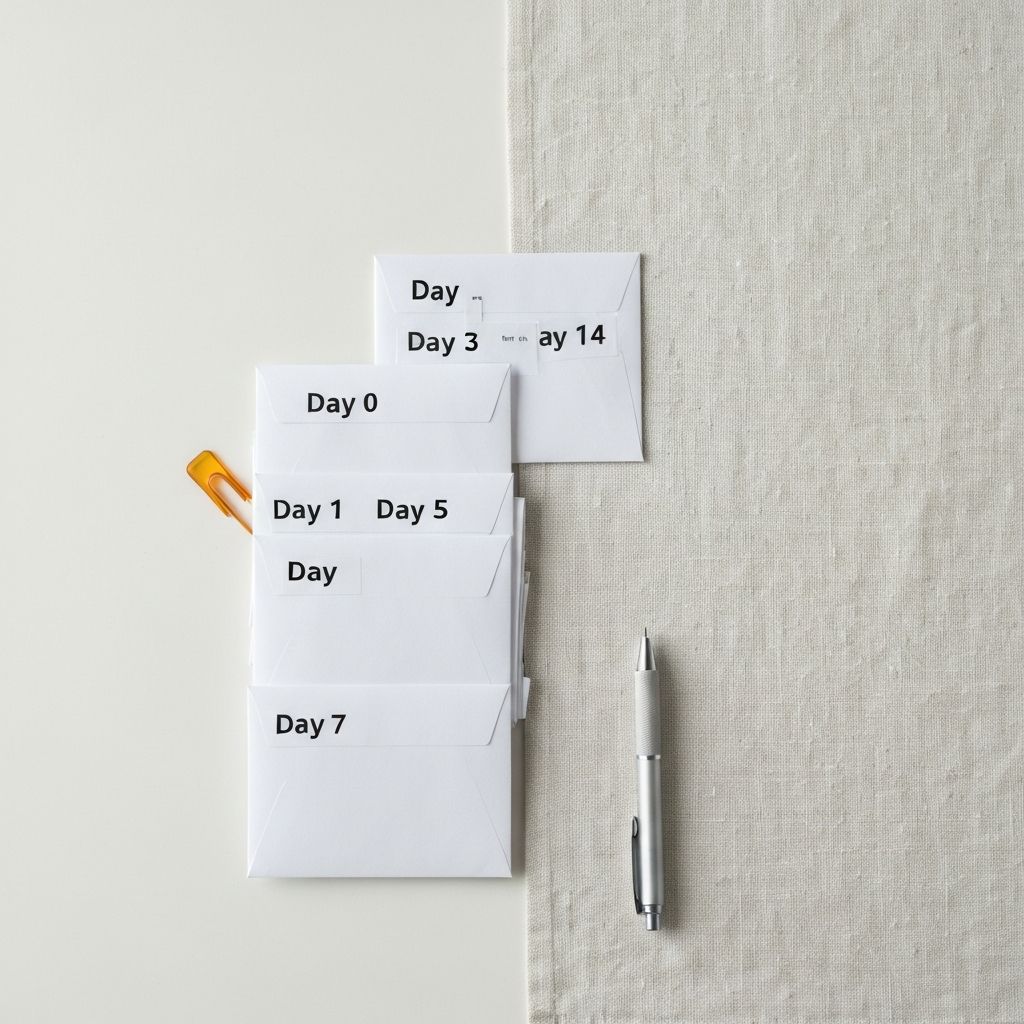
Top-quartile DTC welcome programs send 5.2 emails in the first 14 days after subscribe, front-loaded into days 0 through 7 with a 50/50 split between brand-positioning and offer-led content. The bottom quartile sends 1.8 emails in the same window and skews almost entirely promotional. The difference in subscriber engagement at day 30 between those groups is roughly 2.4×.
The welcome series is the part of a lifecycle program that has the most leverage and the least excuse to be wrong. It's the only flow where every subscriber goes through the same sequence in the same order, which means it's the easiest place to benchmark and the easiest place to fix.
This piece reports the results of a structured analysis of 312 DTC welcome programs across apparel, beauty, food and beverage, home, and supplements — focused on what each program publishes in the first 14 days after a public subscribe.
What we measured
For every program in the sample we captured the canonical welcome series — the version a behavior-neutral subscriber receives, following the monitoring framework we use everywhere else. We then logged:
- Total emails sent in days 0 through 14
- Time-from-subscribe for each email
- Day-of-flow distribution (when in the 14 days each email lands)
- Content type per email (positioning, offer, social proof, education, transactional adjacent)
The sample skews mid-market and above; smaller brands that don't run a structured welcome program were excluded.
The headline numbers
The clearest finding is that the gap between top-quartile and bottom-quartile programs is structural, not cosmetic.
- Top quartile: 5.2 emails in 14 days, day-0 send under 60 minutes, 65% of volume in days 0–7, balanced brand/offer mix.
- Median: 3.4 emails in 14 days, day-0 send under 4 hours, 58% of volume in days 0–7, offer-skewed mix.
- Bottom quartile: 1.8 emails in 14 days, day-0 send delayed by 6+ hours, 71% of volume in days 0–3, almost entirely promotional.
The pattern that produces the day-30 engagement gap isn't volume on its own — it's the combination of fast first send, sustained cadence into days 8–14, and a content mix that doesn't burn out on offer-led messaging in the first 72 hours.
Day 0 — the most leveraged email in the program
The single most important email in the entire welcome series is the first one. Three things separate the top from the bottom:
Speed
Top-quartile programs ship day 0 inside 60 minutes of subscribe. Many ship inside 5 minutes. The bottom quartile typically waits 6 to 24 hours, which means the email arrives after subscriber intent has cooled.
Mix
The top-quartile day-0 email is almost always brand positioning + offer in a single message. It establishes who the brand is, why subscribing was worth it, and gives the subscriber a clear next action. The pure-positioning version (no offer) tends to underperform on first-purchase rate. The pure-offer version (no positioning) tends to underperform on second-purchase rate.
Subject line
The top-quartile pattern is short, declarative, and uses the brand's voice rather than a generic "Welcome." Programs that lead with the brand name in the subject see noticeably higher open rates than programs that lead with "Welcome to [Brand]."
Days 1 through 7 — the dense window
Roughly 65% of total welcome volume lands in this window in top-quartile programs, vs. 58% in median programs. The top-quartile structure is consistent enough to describe as a template:
- Day 0: positioning + offer
- Day 1 or 2: brand story / founder note
- Day 3: social proof or category education
- Day 5: offer reminder, sometimes with urgency
- Day 7: segmentation moment — preference center, category quiz, or product finder
That last one — the segmentation moment — is the move that separates top-quartile programs from everyone else. By day 7 the subscriber either provides preference data and routes into a segmented lifecycle stream, or they don't and they fall back into the default broadcast cadence.
Days 8 through 14 — the bridge
Days 8 through 14 are the bridge from welcome flow to ongoing program. This is the stretch where most bottom-quartile programs simply stop sending, which is why their day-30 engagement collapses. The top-quartile pattern is roughly two emails in this window:
- A category-led education or product story
- A second offer or a curated bestsellers email
Then the subscriber graduates into the regular broadcast and lifecycle calendar, and their experience starts to look like a normal subscriber's.
What the bottom-quartile programs get wrong
Three patterns showed up repeatedly in the bottom of the distribution.
Slow day 0. The single biggest predictor of bottom-quartile performance is a delayed first email. Inside the bottom quartile, day 0 averaged just under 7 hours from subscribe.
Offer-only mix. Bottom-quartile welcome series tend to be 90%+ promotional, which produces a fast initial purchase and then a fast unsubscribe.
Cliff at day 4. Bottom-quartile programs send 1 to 3 emails in the first 72 hours and then go quiet for 10+ days. By the time the broadcast cadence picks up, the subscriber has either bought or already disengaged.
This last pattern is one of the easiest forms of cadence drift to spot — the program looks dense early, hollow in the middle, and never recovers.
Acting on the benchmark
The takeaway for an operator looking at their own program is roughly this:
- If day 0 is slower than 1 hour, fix that first; nothing else in the welcome flow matters as much.
- If you're under 4 emails in 14 days, you're underbuilt; the marginal email almost always pays back.
- If you're over 7 emails in 14 days, audit the offer concentration; you're probably burning subscribers.
- If you're not capturing preference data by day 7, you're losing the chance to segment for the next 6 to 12 months of the relationship.
That's the framework. The benchmark isn't the answer — your program's economics will push the right number a few clicks in either direction — but it's the right starting point for a re-architecture conversation.
Frequently asked questions
Common questions about lifecycle
Written by
Fernando Portela
Founder, Sendsitive
Founder of Sendsitive. I write about competitive email intelligence, lifecycle benchmarks, deliverability, and the operational seams that quietly erode revenue — drawing on the same research engine that powers our product.
Sendsitive Research · Produced with Sendsitive
Read next
Continue your research

The Complete Guide to Competitive Email Intelligence
How modern lifecycle and CRM teams build a structured monitoring program — what to track, how to analyze it, and how to turn it into roadmap decisions.

Cadence Drift: The Slow Decay That Kills Lifecycle Revenue
Lifecycle programs don't fail in a single week — they drift. A diagnostic for spotting cadence decay in your own program before the revenue drop shows up in dashboards.

How to Monitor Your Competitors' Email Campaigns Legally
A practical framework for tracking competitor email programs without violating privacy laws — and the line between public subscription and the things you can't do.
Sendsitive
Stop reverse-engineering screenshots.
Sendsitive aggregates the email and SMS programs your competitors actually ship — with frequency, calendar, and risk signals that update every day. Read the rest of the field reports while you decide whether that's something your team needs.